Key Takeaways
- Vascular dementia develops when blood vessel problems damage areas of the brain.
- It can occur after a stroke or from long-term small blood vessel damage.
- Problems with thinking, attention, planning, and movement may appear early.
- Memory loss can occur but is not always the first symptom.
- The condition can progress through three broad phases or seven stages.
- Managing vascular risk factors may help reduce further brain and blood vessel damage.
Quick Answer
Vascular dementia is a type of dementia caused by reduced blood flow or damage to blood vessels in the brain. It can affect memory, thinking, attention, movement, speech, and mood.
Introduction
Dementia is a general term for problems with memory, thinking, reasoning, language, or other cognitive abilities that interfere with daily life. It is not one specific disease, and different conditions can cause it.
One such condition is vascular dementia, which develops when problems with the brain’s blood vessels reduce blood flow and damage brain cells. It may follow a major stroke, result from several smaller strokes, or develop gradually from small-vessel damage. Depending on the areas affected, it can cause changes in thinking, attention, memory, movement, communication, and daily functioning.
Understanding how vascular cognitive impairment develops and the symptoms and risk factors associated with it can help clarify the condition.
What Is Dementia?
Dementia is a general term for changes in memory, thinking, reasoning, language, or other cognitive abilities that become severe enough to affect everyday life. It is not a single disease. Different conditions can cause dementia, including Alzheimer’s disease, vascular dementia, dementia with Lewy bodies, and frontotemporal dementia.
Dementia can affect people differently. Some may have memory problems, while others may first notice changes in attention, problem-solving, communication, or judgment. It is not a normal part of aging.
Read also: Is Dementia Hereditary? Understanding Your Risk
What Is Vascular Dementia?
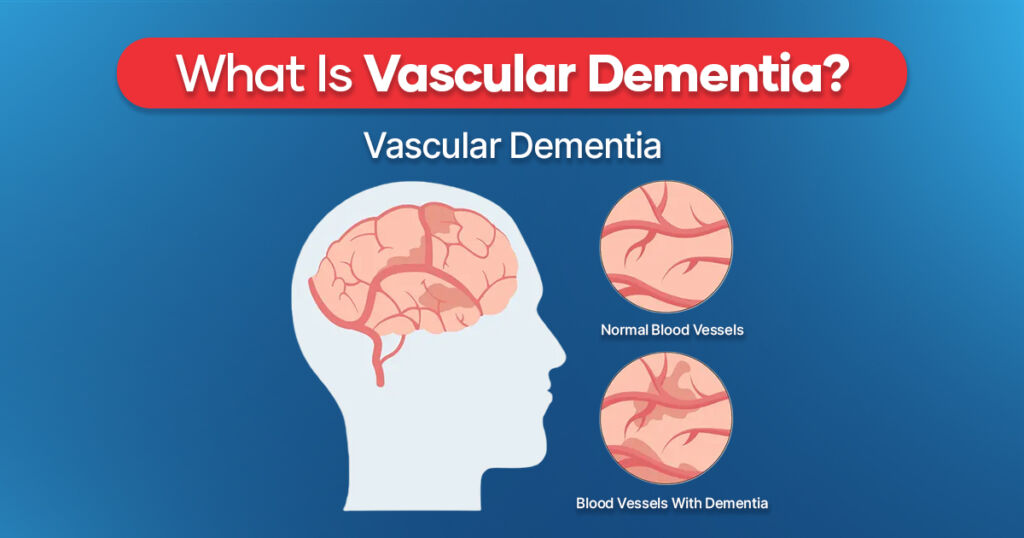
Vascular dementia is caused by problems that affect blood flow to the brain. When blood vessels are narrowed, blocked, or damaged, brain tissue may not receive enough oxygen and nutrients. Repeated or long-term damage can affect areas responsible for attention, planning, reasoning, memory, movement, and communication.
This condition can develop in several ways. Some people develop cognitive changes such as memory loss after stroke, while others experience damage from multiple strokes. In other cases, gradual damage to the brain’s small blood vessels contributes to a slower decline.
Some experts use the broader term vascular cognitive impairment (VCI) because vascular-related changes in thinking can range from mild problems to more severe impairment.
This type of dementia can occur on its own, but it is also common as part of mixed dementia. About 5% to 10% of people with dementia have vascular dementia alone, while vascular changes may also occur alongside other types of dementia, particularly Alzheimer’s disease.
What Are the Types?
Vascular cognitive impairment can develop in different ways depending on which blood vessels are affected and how the brain is damaged. Common forms include:
1. Subcortical Vascular Dementia
This form involves damage to the small blood vessels deep inside the brain, often linked to long-term high blood pressure and other blood vessel problems. It usually develops gradually, with early symptoms such as slower thinking, trouble concentrating, planning, walking, or maintaining balance. Memory problems may occur but are not always the first sign. It may also be called small-vessel vascular dementia or Binswanger disease.
2. Post-Stroke Dementia
Post-stroke dementia can develop when brain damage from stroke affects areas involved in thinking, memory, language, movement, or other functions. Symptoms vary depending on where the stroke occurred and may appear soon after the stroke or during the following months. Not everyone who has a stroke develops dementia.
3. Multi-Infarct Dementia
This type develops after multiple strokes damage different areas of the brain. Some strokes may be obvious, while others may go unnoticed. Symptoms may worsen in a step-like pattern, with periods of stability followed by noticeable decline after another stroke.
4. Mixed Dementia
Mixed dementia occurs when more than one condition contributes to dementia symptoms. A common combination is vascular cognitive impairment and Alzheimer’s disease, which can cause overlapping problems with memory, thinking, and everyday activities.
What Are the Causes?
Several types of vascular damage can contribute to the condition:
Stroke
A stroke occurs when blood flow to part of the brain is interrupted or when a blood vessel in the brain breaks and causes bleeding. A blocked vessel can prevent oxygen from reaching brain cells, while bleeding can damage nearby brain tissue.
Having several strokes over time can increase the risk of vascular cognitive problems. Even strokes that cause few noticeable symptoms can add to overall brain damage.
Narrowed Blood Vessels
Blood vessels can become narrower when fatty substances such as cholesterol build up inside them. This process, called atherosclerosis, can reduce blood flow to the brain and increase the risk of stroke and other blood vessel problems.
Small Blood Vessel Damage
Long-term high blood pressure and other vascular problems can damage the tiny blood vessels deep inside the brain. This damage may affect attention, planning, thinking speed, and movement.
Brain Hemorrhage
Bleeding within the brain can damage brain tissue and contribute to vascular cognitive impairment. High blood pressure can contribute to weakened blood vessels. Another possible factor is cerebral amyloid angiopathy, in which protein deposits can weaken small blood vessels as people age.
Who Is at Risk?
Many of the risk factors for VCI are also risk factors for stroke and heart disease. Some cannot be changed, such as age, while others may be managed through medical care and lifestyle changes.
Common risk factors include:
- High blood pressure: Long-term high blood pressure can place stress on blood vessel walls and contribute to damage.
- Diabetes: High blood sugar can damage blood vessels throughout the body, including those supplying the brain.
- High cholesterol: Cholesterol can contribute to fatty deposits that narrow blood vessels.
- Smoking: Smoking damages blood vessels and increases the risk of stroke and cardiovascular disease.
- Heart disease: Certain heart conditions can increase the risk of blood clots and other problems affecting blood flow to the brain.
- Atrial fibrillation: This irregular heart rhythm can allow blood clots to form in the heart. A clot that travels to the brain can cause a stroke.
- Previous stroke or TIA: A history of stroke or transient ischemic attack can increase the risk of future vascular problems.
- Age: The risk of vascular cognitive impairment increases with age and is uncommon before age 65.
- Other vascular risk factors: Being overweight, not getting enough physical activity, and having a family history of conditions such as high blood pressure or diabetes may also contribute to vascular risk.
What Are the Symptoms?
Vascular cognitive impairment does not look exactly the same in everyone. Symptoms depend partly on which areas of the brain have been damaged and how much damage has occurred.
The vascular dementia symptoms can be grouped into several areas:
| Symptom area | Common symptoms |
|---|---|
| Thinking and concentration | Trouble concentrating, slower processing of information, difficulty following a conversation, trouble switching between tasks, difficulty planning and organizing, problems solving problems, and difficulty making decisions |
| Memory | Forgetfulness or difficulty retrieving information; memory problems may occur without being the earliest or most prominent symptom |
| Movement and balance | Trouble walking, poor balance, slower movements, weakness on one side of the body, and an increased risk of falls |
| Speech and communication | Difficulty finding the right words, understanding language, speaking clearly, reading, or writing |
| Mood and behavior | Depression, anxiety, irritability, apathy, loss of motivation, emotional changes, and becoming less socially engaged |
| Bladder changes | Urinary urgency or difficulty controlling the bladder may occur, although bladder problems can have many other causes |
One noticeable feature can be slowed thinking. A person may take longer to process information, organize a task, or make a decision.
Vascular Dementia vs. Alzheimer’s Disease
Vascular cognitive impairment and Alzheimer’s disease can both cause changes in memory and thinking, but they are associated with different underlying processes.
Vascular dementia is related to blood vessel problems and reduced blood flow in the brain. Alzheimer’s disease is associated with characteristic brain changes involving proteins such as beta-amyloid and tau.
Memory loss is often a major early symptom of Alzheimer’s disease. With VCI, problems with attention, planning, decision-making, and thinking speed may be more noticeable early on.
However, the symptoms can overlap, and a person can have both vascular changes and Alzheimer’s disease. This is one reason why determining the cause of cognitive changes may require a detailed evaluation.
How Is Vascular Dementia Diagnosed?
There is no single test that can diagnose the condition. Healthcare professionals usually consider a person’s symptoms, medical history, cognitive changes, and evidence of stroke-related or blood-vessel-related brain damage.
An evaluation may include:
Medical History
A doctor may ask about when symptoms began and whether the person has had a stroke, TIA, high blood pressure, diabetes, heart disease, or other vascular problems.
Cognitive Testing
Short tests may assess memory, attention, language, reasoning, and problem-solving.
Neurological Examination
A healthcare professional may check movement, strength, coordination, reflexes, balance, and speech.
Brain Imaging
An MRI or CT scan may help identify previous strokes, bleeding, or changes associated with small-vessel disease.
Blood Tests
Blood tests may help identify other conditions that could contribute to memory or thinking problems.
Because symptoms can overlap between different types of dementia, doctors may also consider other possible causes of cognitive decline.
Can The Condition Be Treated?
There is currently no treatment available for vascular cognitive impairment. Care generally focuses on two main goals:
- Reducing the risk of further blood vessel damage.
- Managing symptoms and supporting daily function.
Depending on the person’s health and diagnosis, a doctor may recommend managing conditions such as:
- High blood pressure
- Diabetes
- High cholesterol
- Heart disease
- Abnormal heart rhythms
The following lifestyle changes may also be included as part of care:
- Regular physical activity
- A balanced diet
- Quit smoking
- Maintaining a healthy weight
- Limiting alcohol
Some people may also benefit from rehabilitation, cognitive support, occupational therapy, speech therapy, or treatment for depressive personality disorder and other behavioral symptoms.
Currently, there is no FDA-approved medication specifically for vascular dementia treatment. Some medications used for Alzheimer’s disease may sometimes be considered when Alzheimer’s disease and vascular cognitive impairment occur together, depending on the individual’s diagnosis and medical needs.
What Are Vascular Dementia Stages?
The vascular changes often progress in a step-like manner through early, middle, and late phases, though clinicians sometimes map it onto a seven-stage scale adapted from general cognitive decline.
Three Broad Phases of Vascular Cognitive Impairment
| Phase | General changes |
|---|---|
| Early stage | Thinking may slow, with problems with planning, attention, or concentration. Most daily activities can still be managed independently. |
| Middle stage | Confusion, communication difficulties, and problems with everyday tasks may become more noticeable. |
| Late stage | Severe cognitive and physical difficulties may develop, with increasing dependence on caregivers. |
Seven Stages of Vascular Cognitive Impairment
| Stage | General description |
|---|---|
| Stage 1: Normal behavior | No obvious cognitive or behavioral changes. |
| Stage 2: Very mild decline | Occasional forgetfulness that may resemble normal age-related changes. |
| Stage 3: Mild decline | More noticeable difficulties with concentration, organization, or memory. |
| Stage 4: Moderate decline | Greater difficulty with complex tasks, problem-solving, and recalling recent events. |
| Stage 5: Moderately severe decline | Memory problems become more significant and help with some daily activities may be needed. |
| Stage 6: Severe decline | Increasing difficulty with surroundings, recognition, communication, and everyday activities may occur. |
| Stage 7: Very severe decline | Extensive support may be needed, with severe communication and mobility difficulties possible. |
Note: These stages are general descriptions rather than a set progression. The condition may develop gradually or worsen in steps, and each person’s symptoms and rate of progression can differ.
Is Vascular Dementia Hereditary?
VCI is usually not directly inherited, but genetics can affect the risk of conditions that damage blood vessels, such as high blood pressure, diabetes, and stroke. Rare inherited conditions, such as CADASIL, can directly affect brain blood vessels. Having a family history does not mean someone will necessarily develop vascular cognitive impairment.
Can Vascular Dementia Be Reversed?
The condition generally cannot be completely reversed once permanent brain damage has occurred. However, managing conditions such as high blood pressure, diabetes, and high cholesterol may help reduce further blood vessel damage. Symptoms and progression can vary from person to person.
Outlook/Prognosis
Vascular dementia can affect overall health and life expectancy, particularly because it is often associated with stroke, heart disease, and other serious health conditions. However, there is no single life expectancy that applies to everyone with this type of dementia.
A person’s outlook may depend on factors such as age, general health, the amount and location of brain damage, previous strokes, and whether additional vascular problems develop.
Population-level estimates should not be used to predict how long a particular person will live. Individual experiences can vary considerably.
When Should You See a Doctor?
Talk with a healthcare professional if you or someone you care about develops ongoing changes such as:
- Increasing forgetfulness
- Trouble concentrating
- Difficulty planning or organizing
- Problems making decisions
- Changes in speech or understanding
- Difficulty managing familiar tasks
- Changes in walking or balance
- Significant changes in mood or behavior
An evaluation can help determine whether these changes are related to VCI, another type of dementia, or another condition. Some causes of memory and thinking problems may be treatable, making an appropriate medical evaluation important.
Vascular Dementia and Clinical Research Studies
Researchers continue to study vascular cognitive impairment to better understand how blood vessel damage affects the brain and to evaluate potential new treatments. Neurology research studies may evaluate an investigational treatment to learn more about its safety, effects, and potential role in managing vascular-related cognitive changes.
Ongoing clinical research studies may involve regular health assessments, cognitive testing, brain imaging, or other study-related procedures. Each study has its own eligibility requirements, potential risks, and procedures. Participation is voluntary, and people considering a study should discuss the details with the research team and their healthcare professional.
Conclusion
Vascular dementia is a brain blood vessel disease that can affect memory, thinking, movement, and daily functioning. It may develop after a stroke or from long-term damage to the brain’s blood vessels. Managing vascular risk factors is an important part of care and may help reduce further damage. Research continues to explore the causes, prevention, and treatment of vascular cognitive impairment. Zillan Clinical Research supports ongoing research into neurological conditions and disorders affecting the brain and nervous system.
Frequently Asked Questions
1. Is vascular dementia the same as Alzheimer’s disease?
No. They are different types of dementia. VCI results from blood vessel damage and reduced blood flow to the brain, while Alzheimer’s involves different brain changes. Both can occur together.
2. How long will a person live with vascular dementia?
Vascular dementia life expectancy varies. It depends on factors such as age, overall health, stroke history, and whether additional strokes or other health problems occur.
3. What is the main cause of vascular dementia?
It is caused by reduced or blocked blood flow to the brain that damages brain cells. Stroke and long-term small blood vessel damage are common causes.
4. What is the difference between vascular dementia and dementia?
Dementia is a general term for problems with memory and thinking. VCI is a specific type caused by reduced blood flow or blood vessel damage in the brain.
5. Can vascular dementia be cured?
There is currently no cure that reverses established vascular cognitive impairment. Treatment focuses on managing symptoms and reducing the risk of further blood vessel damage and strokes.
Medical Disclaimer: This content is for general educational purposes only and is not a substitute for professional medical advice, diagnosis, or treatment. Always consult a qualified healthcare professional for medical concerns.