
Join Night Vision Disturbance Clinical Trials Focused on Improving Low-Light Vision After Refractive Surgery

Night Vision Disturbance Clinical Trials in Houston, TX
Do glare, halos, starbursts, or difficulty seeing in low-light settings make nighttime activities more challenging than they should be? Night vision disturbances can affect visual clarity and confidence after procedures such as LASIK, PRK, SMILE, and other keratorefractive surgeries. These symptoms may become more noticeable in dim environments, impacting driving, reading signs, and overall quality of life.
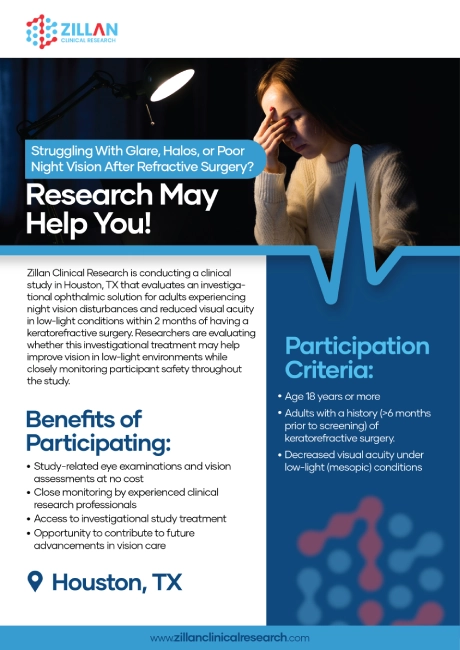
Zillan Clinical Research is conducting Phase III night vision disturbance clinical trials for adults who first noticed night vision symptoms within 2 months after keratorefractive surgery. Eligible participants may receive study-related care, vision tests, and study treatment at no cost.
About This Study
Advancing Breakthroughs for Better Vision in Low-Light Conditions
For some individuals, vision challenges don’t end after refractive surgery. Dim light vision disturbances such as glare, halos, starbursts, and reduced clarity can continue to affect everyday activities long after recovery.
The current night vision disturbance clinical trials at Zillan Clinical Research are evaluating the safety and effectiveness of an investigational ophthalmic solution for adults experiencing decreased mesopic (low-light) visual clarity and night vision disturbances following keratorefractive surgery. Eligible participants receive the study medication or control drug once daily for 14 days and undergo vision assessments, eye examinations, and close safety monitoring throughout the study, at no cost.
Now Enrolling
Night Vision Disturbance Following Keratorefractive Surgery
Why Patients Trust Us
At Zillan Clinical Research, we combine patient-centered care with the highest standards of clinical research to help advance innovative ophthalmic treatments.

High Investigator Involvement

Phase I–IV Research Expertise

Quality First Culture

Global Research Partnerships

Participant-Focused Experience

Trusted Clinical Standards
FAQ
Frequently Asked Questions
What are night vision disturbance clinical trials?
These clinical trials are research studies evaluating investigational treatments designed to improve visual performance in low-light conditions for individuals experiencing symptoms such as glare, halos, starbursts, or reduced night vision.
Who may qualify for these studies?
Adults 18 years of age or older, who previously underwent keratorefractive surgery and continue to experience night vision symptoms may be eligible, depending on specific study requirements.
What are dim light vision disturbances?
It refers to visual symptoms that occur in low-light environments, including difficulty seeing clearly at night, glare, halos around lights, and reduced visual sharpness.
What happens during the study?
Participants take the study medication or placebo once daily for two weeks, attend scheduled clinic visits (2 clinic visits over 14 days), complete vision testing, and receive ongoing safety monitoring.
What is the goal of this research?
The goal is to evaluate whether an investigational ophthalmic solution can safely improve visual acuity and overall visual performance under low-light conditions.
Are night vision disturbance clinical trials safe?
Participant safety is the top priority. The study follows strict regulatory and ethical standards, and all participants are closely monitored throughout. As with any investigational treatment, participants are informed of potential risks before enrolling.
Still have questions? Our team is here to support you with your clinical research needs.
Join Us
Supporting Innovation
Through Clinical Trials
Join studies designed to advance medical knowledge and support the development of next-generation therapies.