Skip to content Skip to footer

Night Blindness vs Normal Vision: How to Tell the Difference

Night Blindness Vs Normal Vision

 Key Takeaways

  • Everyone sees less in the dark. When comparing night blindness vs. normal vision, the real question is whether you see much worse than other people, or worse than you used to.
  • Healthy eyes adjust to dim light in about 20 to 30 minutes. With night blindness, adjustment is very slow or never fully happens.
  • Night blindness is a symptom, not a disease, and many of its causes are treatable.
  • Trouble in the dark combined with shrinking side vision needs prompt attention from an eye specialist.

Quick Answer

Normal night vision means your eyes gradually adjust to darkness, letting you make out shapes and movement even though colors and fine details look dull. Night blindness (nyctalopia) means your eyes struggle to adjust at all, so you may bump into objects, find night driving frightening, or feel lost in dim rooms that others handle easily.

Introduction

Think about the last time you walked into a dark cinema. For a few moments, you could barely find your seat. Then, slowly, shapes appeared. That is completely normal.

Now imagine the shapes never really appear. Friends move around easily while you reach for the wall. Driving home after sunset feels stressful, and you start skipping evening plans without quite knowing why.

Many people live with this for years and assume their eyes are simply “bad at night.” Sometimes that is true. But sometimes it is an early sign of a condition that can be treated or monitored.

This blog explains night blindness vs normal vision in plain language, including how each works, what causes the problem, and when it is time to see an eye doctor.

What Is Normal Vision and How Night Vision Works?

Normal vision means your eyes can see clearly in bright light and still adapt sensibly when light fades. At the back of your eye is the retina, a thin layer packed with two types of light-sensing cells.

  • Cones handle color and sharp detail in bright light.
  • Rods take over in dim light, picking up shapes, outlines, and movement, though not color.

When the lights go down, your pupils widen to let in more light and your rods become more sensitive. Rods depend on a pigment called rhodopsin, which your body makes using vitamin A. That is why nutrition plays a role in how well you see at night.

In a healthy eye, you can expect the following:

  • A few minutes to start seeing shapes, and around 20 to 30 minutes to reach your best night vision
  • Faded colors and difficulty reading small print
  • Glare from bright headlights, with a quick recovery afterward
  • Night vision that is about the same as other people your age

Seeing less in the dark is not a disorder. It is simply how human eyes are built.

What Is Night Blindness?

Night blindness means your eyes cannot adapt properly to low light. Despite the name, most people with it are not completely blind in the dark. They just see far less than they should or take much longer to adjust.

Many people ask, is night blindness real? It is. Known medically as nyctalopia, it is a recognized symptom rather than a disease on its own. It signals that something is affecting how your eyes handle low light, such as vitamin A deficiency, cataracts, or an inherited retinal condition.

Common signs

  • Tripping or bumping into things in dim rooms
  • Taking much longer than others to see after entering a dark space
  • Struggling at dusk or twilight
  • Finding night driving stressful or unsafe, especially with oncoming headlights
  • Avoiding dim restaurants, cinemas, or unlit streets

Often there is a sense that the problem is slowly getting worse, or that it appeared quite suddenly.

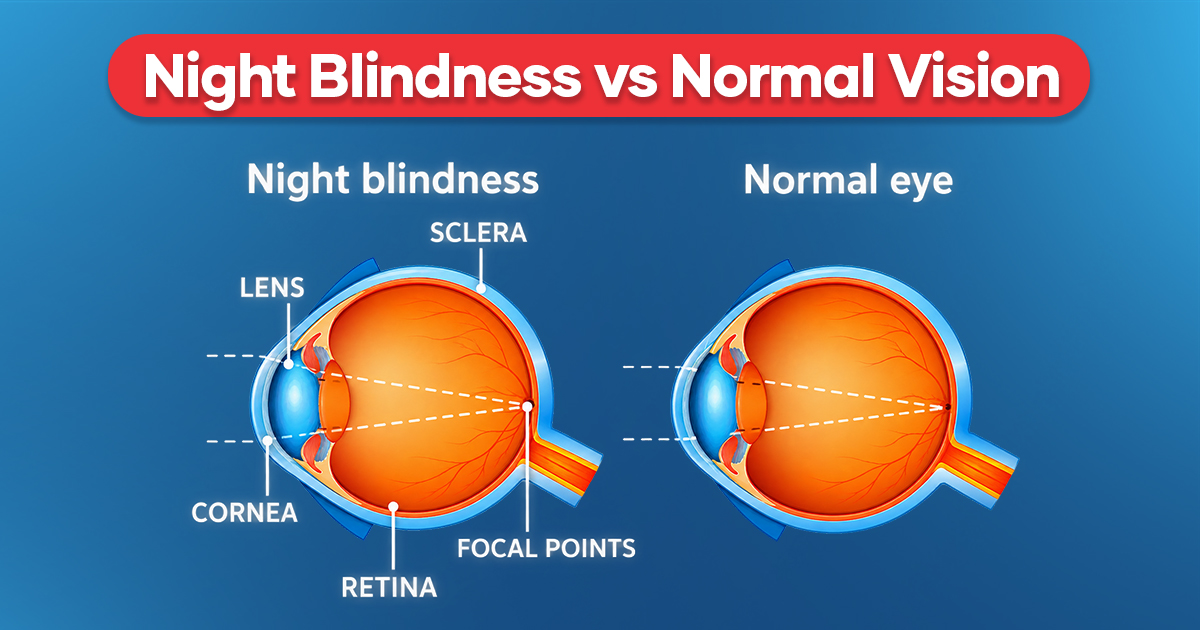
Night Blindness vs Normal Vision: What’s The Difference

The clearest way to tell the difference between night blindness and normal vision is to compare how they feel in everyday situations.

What you noticeNormal night visionNight blindness
Moving from light to darkImproves within minutesSlow, weak, or no improvement
Seeing in a dim roomShapes and outlines visibleObjects may be invisible
Night drivingManageable, with some glareHard, stressful, or unsafe
Compared with othersAbout the sameClearly worse
Change over timeStableOften worsens or appears suddenly

A simple self-check can help: ask yourself whether you see much worse than the people around you in the same light. If the answer is yes, an eye exam is worth booking.
What Causes Night Blindness?

The causes range from simple to serious, and a good number can be fixed.

Common and treatable causes

  • Near sightedness (myopia): Uncorrected prescriptions often look worse at night, when pupils are wider.
  • Cataracts: A cloudy lens scatters light, which can cause cloudy vision, glare, halos, and poor contrast in dim conditions. Cataract surgery can often restore clearer sight.
  • Vitamin A deficiency: Without enough vitamin A, rods cannot work properly. This is a leading cause of night blindness worldwide.
  • Certain medicines: Some glaucoma eye drops shrink the pupil and reduce the light entering the eye.
  • Diabetes: Changes in the retina can affect night vision.

Inherited and long-term causes

  • Retinitis pigmentosa: A group of genetic conditions that gradually damage the rods. Night blindness is usually the first sign, followed by shrinking side vision.
  • Congenital stationary night blindness: A rare condition present from birth that usually does not worsen.
  • Usher syndrome: A genetic condition affecting both vision and hearing.

Because the possibilities are so different, guessing the cause on your own is risky.

How Do Doctors Find the Cause?

Finding the reason behind poor night vision usually starts with a simple eye exam and moves to more specialized tests only if needed.

An eye specialist (ophthalmologist or optometrist) may use:

  • Comprehensive eye exam to check for refractive error, cataracts, and glaucoma.
  • Dilated retinal exam to look for retinal damage or pigment changes.
  • Visual field test to detect tunnel vision.
  • Electroretinogram (ERG), which measures how the retina’s cells respond to light.
  • Dark adaptation testing, which measures how quickly your eyes adjust.
  • Blood tests to check vitamin A levels and screen for diabetes.
  • Genetic testing if an inherited condition is suspected.

Can Night Blindness Be Treated?

It depends entirely on what is causing it. The good news is that many causes are fixable once they are found.

Treatment usually depends on the cause:

  • Uncorrected vision: updated glasses or contact lenses
  • Cataracts: cataract surgery to replace the cloudy lens
  • Vitamin A deficiency: diet changes or supplements, guided by a doctor
  • Medication side effects: your doctor can review alternatives
  • Diabetes: steady blood sugar control and regular retina checks
  • Retinitis pigmentosa: ongoing monitoring, low-vision support, and research-based options for certain genetic types

Inherited conditions such as retinitis pigmentosa are harder to treat. There is no cure for most forms, but regular monitoring and support can help people stay independent for longer.

A Word of Caution on Vitamin A

More is not better. Too much vitamin A can be harmful, particularly during pregnancy, so avoid high-dose supplements unless a doctor advises them. For most people, a balanced diet is enough.

Foods that support healthy vision:

  • Carrots, sweet potatoes, and pumpkin
  • Spinach, kale, and other leafy greens
  • Mangoes and papayas
  • Eggs, dairy, and fish

Carrots will not give you “super” night vision, though. They only help prevent a deficiency.

When Should You See an Eye Doctor?

Book an appointment if:

  • Your night vision has worsened over weeks or months
  • You see well by day but struggle badly after sunset
  • You notice tunnel vision, halos, or severe glare
  • Your child seems unusually afraid or clumsy in the dark
  • Retinitis pigmentosa runs in your family
  • You have diabetes or a condition that affects nutrient absorption

Seek urgent care for sudden vision loss, flashes of light, or a curtain-like shadow across your vision. Until you have been examined, avoid night driving if you feel unsafe.

How Clinical Research Is Advancing Night Vision Care

Eye researchers around the world continue to study why some people struggle in low light. This work falls under night vision disturbance clinical trials, which look at inherited retinal diseases, nutritional causes, and age-related changes. Understanding night blindness vs normal vision helps researchers decide who may be suited to a study and how to measure changes in vision.

Through our clinical research studies, we take part in this work by helping evaluate whether new approaches to eye care are safe and effective. We work alongside doctors, investigators, and volunteers to gather reliable evidence that can inform future care.

Every study we support is voluntary, ethically overseen, and designed with participant safety in mind. If you live with a long-term night vision condition, ask your eye doctor whether a research study might be an option for you.

Night Vision Disturbance Clinical Trials

When Darkness Changes Your Vision

Explore Night Vision Disturbance clinical trials and see if you may qualify to help advance research for better eye health.

Conclusion

Seeing less in the dark is normal. Needing a long time to adjust, struggling to move around safely, or noticing your night vision getting worse is not. The difference between night blindness vs. normal vision is simple: normal eyes adapt, and eyes with night blindness do not.

The encouraging news is that night blindness is often treatable or manageable once the cause is found. Ongoing ophthalmology clinical trials continue to improve how eye conditions are understood and managed, and organizations such as Zillan Clinical Research contribute to this progress through responsible, patient-focused research.

If your eyes struggle after dark, do not wait. Book an exam and get answers.

Frequently Asked Questions

Does night blindness get worse with age?

It can. Pupils shrink, lenses become cloudier with age, and cataracts become more common. Any noticeable decline should be checked by an eye doctor.

Can night blindness be cured?

It depends on the cause. Glasses, cataract surgery, or vitamin A correction can often fix it, while inherited causes like retinitis pigmentosa are usually managed rather than cured.

How long should it take my eyes to adjust to the dark?

You should notice improvement within a few minutes, and your best night vision is typically reached in about 20 to 30 minutes.

Do carrots really improve night vision?

Yes, but only if you have low levels of vitamin A. If your levels are already healthy, extra carrots will not sharpen your sight.

Can children have night blindness?

Yes. It can occur with vitamin A deficiency or, rarely, with inherited conditions. See an eye doctor if your child seems unusually fearful or clumsy in dim light.

Medical Disclaimer: This blog is for educational purposes only and does not replace professional medical advice, diagnosis, or treatment. Please consult a qualified professional for related health concerns.

Leave a Comment